

A 186-unit Tucson casita community came to us with six different color schemes — the kind of multi-scheme exterior repaint that looks like one project from the curb but is really six projects stacked on top of each other. The work isn’t really about paint. It’s about planning.
That’s the part most owners and property managers don’t see until something goes wrong: in a multi-scheme community, the difference between a repaint that elevates the asset and one that creates expensive callbacks comes down almost entirely to what happens before the first sprayer ever pulls a trigger. Below is how American Exterior Systems (AES) is approaching this Tucson project — and the principles we apply to every multifamily community we touch.
The project at a glance
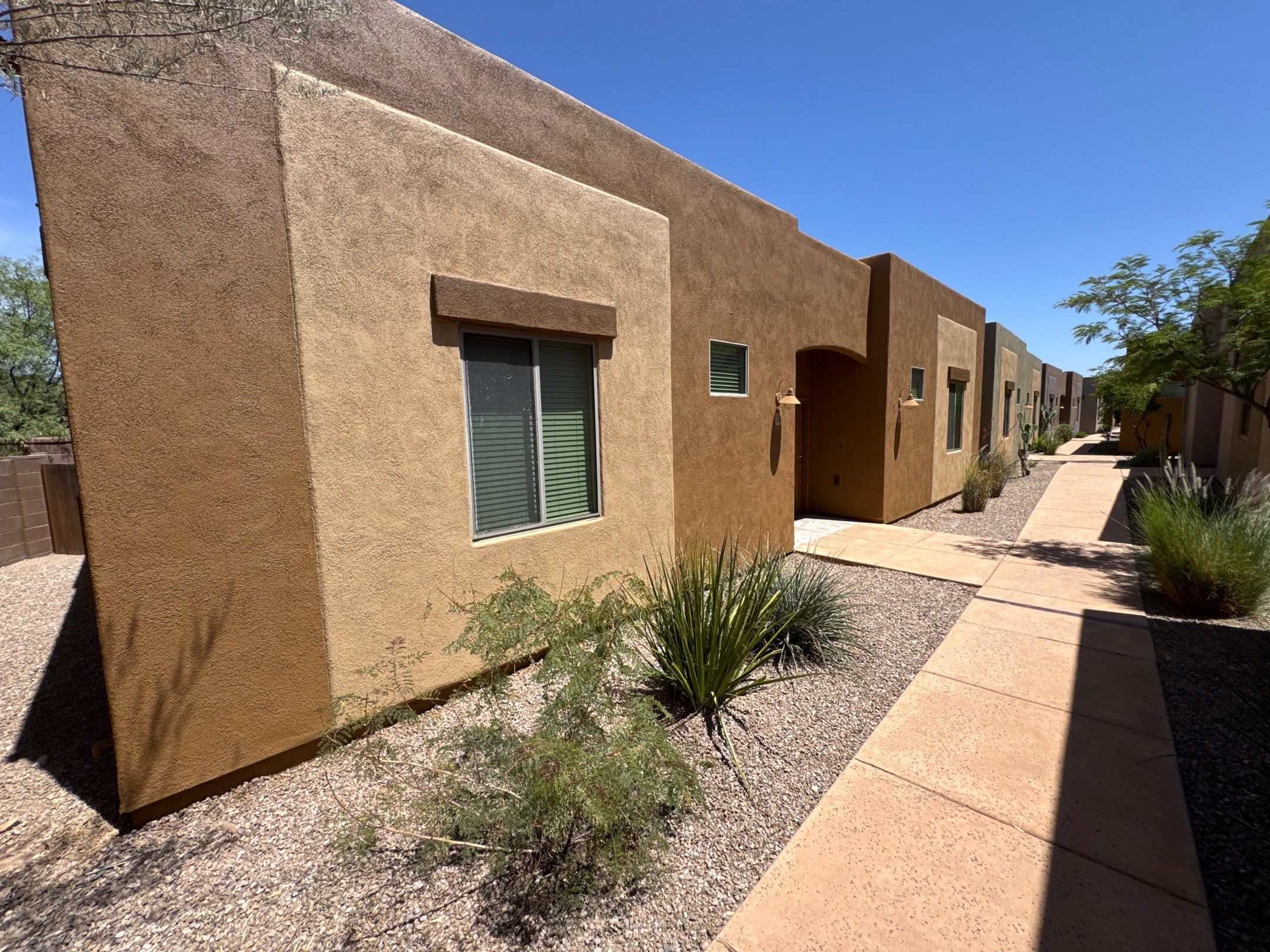
The community is a 186-casita rental property in the Tucson market, built in the classic Sonoran territorial style — deep-set window punches, parapet rooflines, gooseneck sconces, and stucco walls that have to hold up against intense desert UV, monsoon swings, and decades of sun exposure. The original architect specified six distinct color schemes across the property, intentionally rotated so no two adjacent buildings read the same. It’s a beautiful design move. It’s also a paint contractor’s stress test.
Our scope covers a full exterior repaint of all 186 units, including stucco prep and repair, trim, doors, fascia, and the gooseneck light housings — all while residents continue living on-site and the leasing team continues showing units.
Why multi-scheme communities go sideways
From the outside, a six-scheme community looks like one project. From a planning standpoint, it’s six projects stacked on top of each other — and the most common ways they fail are predictable:
Schemes get mixed up at the unit level. One painter grabs the wrong five-gallon, and now Building 14 has Building 7’s accent color. The fix isn’t a touch-up — it’s a full re-coat of an elevation.
Color drift between batches. On a project this size, paint is mixed in multiple batches over multiple weeks. Without batch-tracking by elevation, two halves of the same wall can read as different colors in afternoon light.
The “scheme map” lives in one person’s head. The superintendent knows which casita gets which scheme, but the crew that shows up on Tuesday morning doesn’t. Productivity drops, mistakes climb.
Sample approvals slip. The owner approves swatches in an office. Those swatches read completely differently on stucco at 3 p.m. in Tucson sun. If you don’t catch that before mobilizing, you catch it after.
How we plan a job like this
We treat the planning phase as a deliverable in its own right — not a step on the way to “real” work. For a property of this scale and complexity, that means four things happen before any production work begins.
1. A scheme map, building by building. Every casita is assigned to one of the six schemes on a master site map, with body, trim, accent, door, and fascia colors called out by manufacturer code and batch reference. Every superintendent and lead painter gets the same map. The map is the single source of truth.
2. Field-verified samples. Before owner approval, we put real samples on real stucco — multiple elevations, multiple times of day. Desert light is unforgiving, and a color that reads warm at 9 a.m. can read pink at 5 p.m. Approving on the wall, not on a fan deck, prevents the most expensive kind of change order.
3. Batch and lot tracking. Every gallon coming onto the site is logged against a building number. If we ever need to touch up Building 47 in two years, we know exactly which batch went on it. Owners get this documentation in the closeout package.
4. A resident-friendly sequence. 186 occupied units means we plan around residents — not the other way around. Notices go out 72 hours in advance, work windows respect quiet hours, and walkways stay clear. It’s slower per day than an empty community, but it protects the owner’s renewal numbers.
What this means for owners
The reason a project like this matters for owners isn’t aesthetic — it’s financial. A clean, well-executed multi-scheme exterior repaint protects stucco substrate, extends the next paint cycle by years, and measurably moves the needle on curb appeal during lease-up. Done badly, the same project creates callbacks, owner-funded re-coats, and a community that looks worse two years in than it did the day the crews left.
Six schemes across 186 units is the kind of job where the difference between those two outcomes is decided in the first two weeks of planning. That’s where we spend our energy — so the painting itself becomes the easy part.
Considering a multi-scheme repaint?
If you own or manage a community with multiple color schemes and you’re weighing a full exterior repaint, we’re happy to walk through your property with you and put together a planning approach before you ever see a price. Contact AES to schedule a 15-minute portfolio call.